

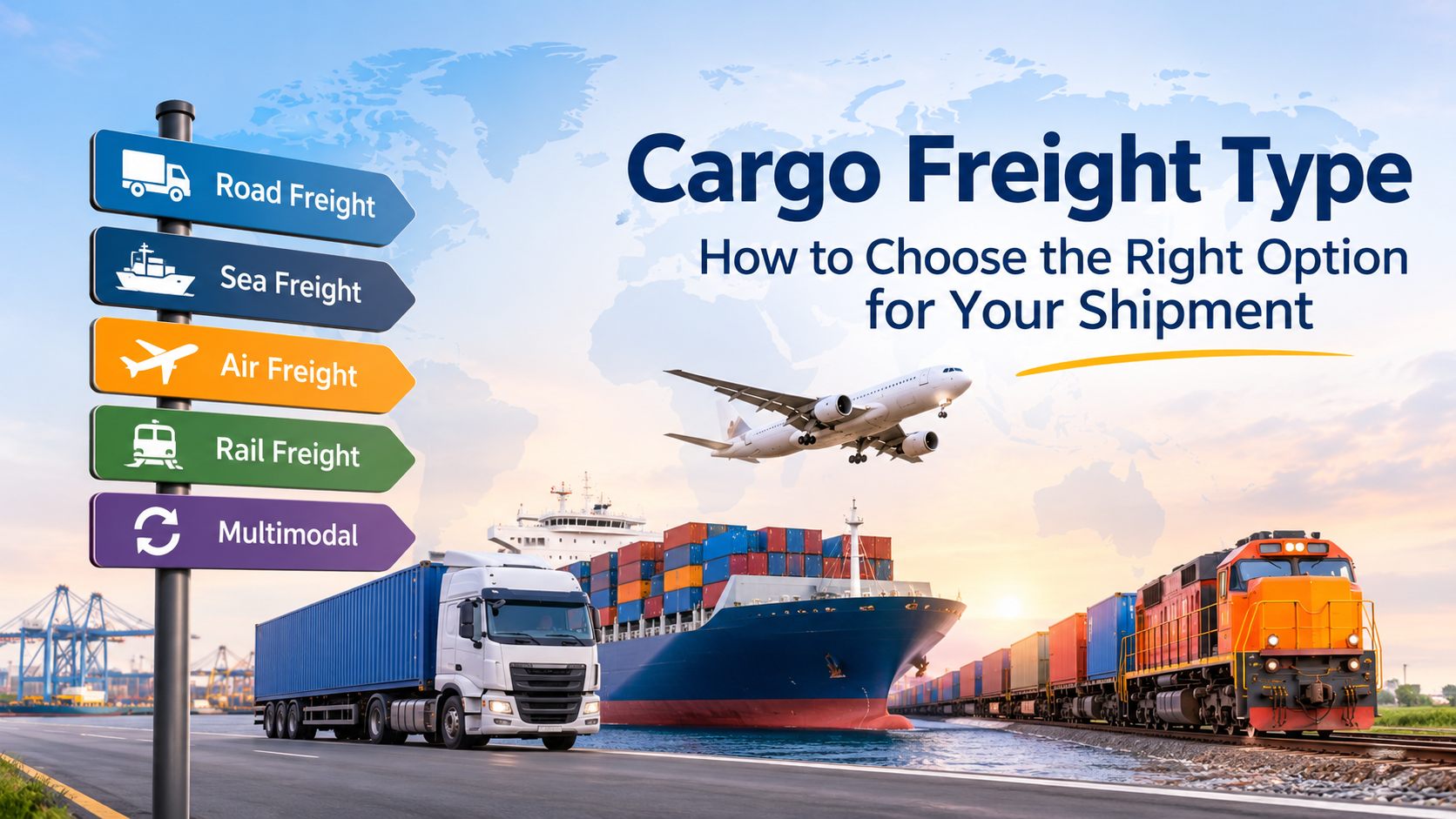
Quick answer: The right cargo freight type depends on five things: what you are shipping, its weight and volume, how soon it must arrive, where it is going, and your budget. Air freight suits urgent, high-value goods. Sea freight suits large international shipments. Road freight suits short to medium inland routes and door-to-door delivery. Rail suits bulk cargo moving long distances overland. Multimodal transport combines these when one mode cannot cover the full journey.
Choosing the wrong option can mean paying for speed you do not need, or missing a delivery date to save money. This guide from Fletching Logistics explains how each option works and gives you a clear process for making the decision.
A cargo freight type is the way goods are classified and moved from origin to destination. In practice, the term covers two connected decisions:
The cargo category usually narrows your choice of mode. Cost and timing then help you make the final decision.
Road is the most flexible cargo freight type for inland movement because trucks can collect from and deliver to the exact address. It works well for factory-to-port transfers, distribution to retailers and final-mile delivery. Fletching Logistics provides cargo freight type solutions by road, tailored to the cargo, delivery timeline and business need.
Sea freight is usually the most economical choice for moving large volumes internationally. You can book a full container load (FCL), where a container is reserved for your goods, or less than container load (LCL), where you share container space with other shippers.
Air freight is the choice when time matters more than cost. It is common for urgent spare parts, electronics, pharmaceuticals, samples and other goods where a delay would cost more than the higher freight rate.
Rail freight is well suited to bulk cargo and long-distance inland transport. It can move heavy loads steadily, though road transport is often needed at either end.
Multimodal transport links two or more modes in one planned journey, such as truck to port, vessel overseas, then truck to the customer. For Sri Lankan businesses, this is common: international cargo leaves the island by sea or air, with road transport handling the inland legs.
Write down exactly what you are shipping. Note whether it is perishable, fragile, hazardous, high-value or oversized, and confirm its HS code. These details determine which carriers can accept it and what handling it needs.
Record the gross weight, carton count and dimensions, then calculate the volume in cubic metres (CBM). Light but bulky goods may be charged on volume rather than actual weight.
Work back from the date the goods are actually needed. Include time for packing, documentation, customs clearance and final delivery, not only time in transit.
List the pickup point, port or airport of departure, destination port or airport, and final delivery address. This shows whether one mode is enough or a multimodal plan is required.
Look beyond the freight rate. Include origin and destination charges, duties, insurance, storage and inland delivery. Also consider the inventory cost of having goods in transit for longer.
Confirm the commercial invoice, packing list, permits and any licences needed. Dangerous goods must be declared and meet the rules for the chosen mode, including the IMDG Code for sea and the IATA Dangerous Goods Regulations for air. A customs brokerage specialist can help prevent clearance delays.
Ask for a quote based on your actual details, and compare at least two realistic options. Agree on the Incoterm, so it is clear who pays for and manages each stage of the journey.
For large international shipments, sea freight is usually the cheapest per kilogram. For short inland journeys, road freight is normally the most practical and cost-effective option.
Air freight is the fastest option for international shipments. For local and short-distance routes, a direct truck can be quicker because it avoids airport handling.
Carriers often compare actual weight with volumetric weight and charge the higher figure. Air cargo commonly uses this formula: length × width × height in centimetres ÷ 6,000. A 100 kg shipment measuring 1 CBM has a volumetric weight of about 167 kg, so it would be billed at 167 kg. Divisors can vary by carrier, so confirm this on your quote.
As a rough guide, compare both once your shipment reaches about 13 to 15 CBM. FCL can become better value at that point, and it also reduces handling because your goods do not share a container.
The main factors are cargo nature, weight, volume, deadline, route, budget and regulatory requirements.
Road transport is generally the best fit because it offers direct delivery to the destination. You can explore this cargo freight type for local and short to medium distance movements.
Yes. Many international shipments use road transport to reach a port or airport, then sea or air for the main journey, and road again for final delivery.
The core customs process is similar, but documents differ. Sea shipments use a bill of lading, while air shipments use an air waybill. Cargo category can also trigger extra permits or inspections.
Provide the cargo description, weight, dimensions, packaging, pickup and delivery locations, ready date, required delivery date and any special handling needs.
The best choice balances cargo safety, delivery time, compliance and total cost. If you are comparing options, share your shipment details with Fletching Logistics and find the right cargo freight type for your route, timeline and budget.