

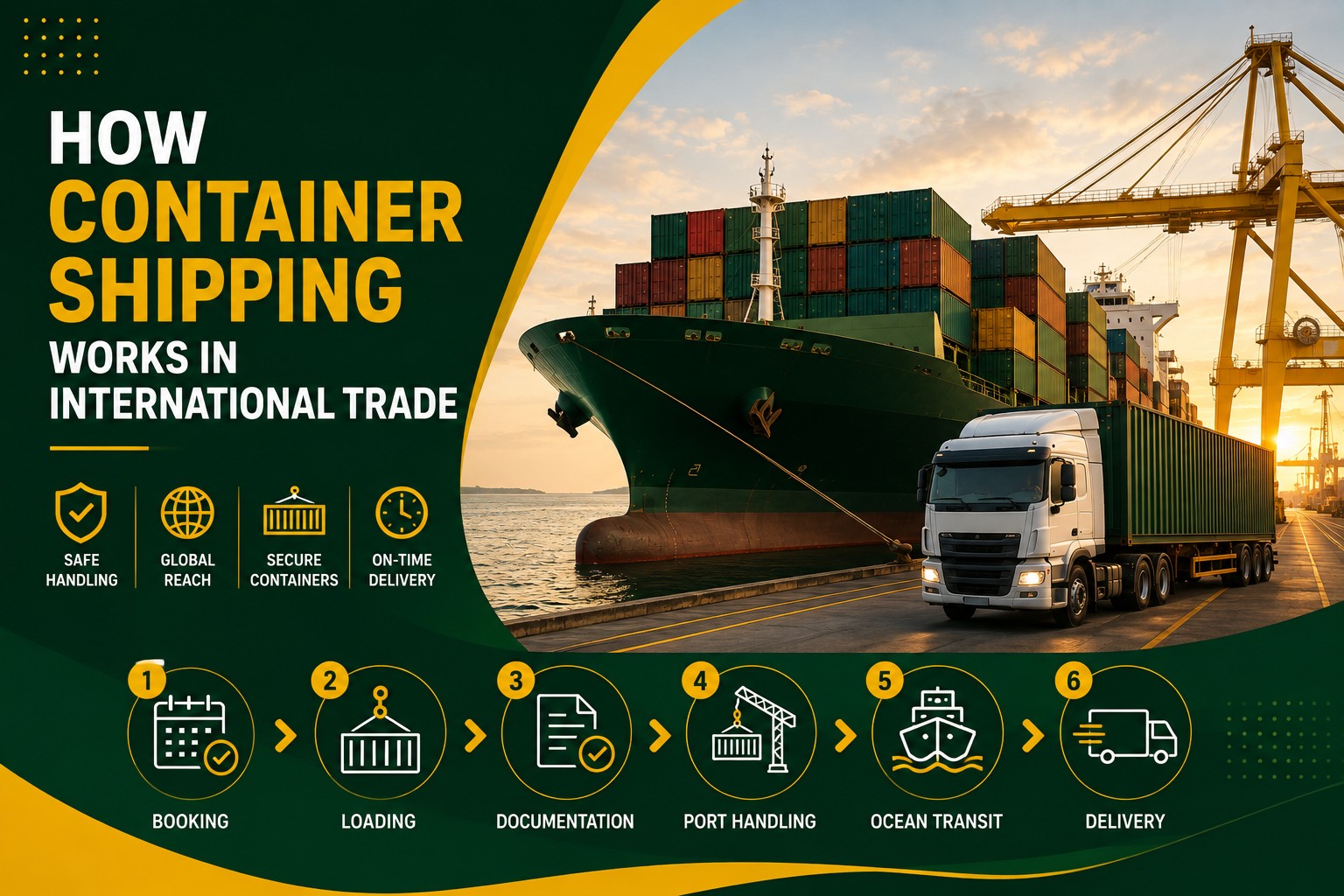
Container shipping is the backbone of global trade. More than 80% of everything transported internationally — electronics, clothing, machinery, food, raw materials, and consumer goods — moves inside standardised steel containers on ocean vessels. Understanding how container shipping actually works helps businesses make better decisions about how their cargo is booked, moved, documented, and delivered.
This guide explains the full container shipping process from start to finish, covers the key decisions importers and exporters need to make, and answers the questions businesses most frequently search before shipping internationally for the first time.
Container shipping is the transportation of goods sealed inside standardised steel containers — typically 20-foot or 40-foot units — on ocean cargo vessels. The standardisation of container sizes is what makes global trade as efficient as it is: the same container can be loaded onto a truck, transferred to a rail line, lifted by a port crane, and stacked on a vessel, all without the cargo inside ever needing to be rehandled.
This intermodal compatibility — the ability to move the same sealed unit across multiple transport types without unpacking — transformed global trade when it was introduced in the 1950s and remains the foundation of international logistics today.
Not all cargo ships in the same container. The main types used in international container shipping include:
Standard Dry Containers (20ft and 40ft) — the most common type, used for general cargo including manufactured goods, packaged products, clothing, machinery, and non-perishables. The 20-foot container (1 TEU — Twenty-foot Equivalent Unit) holds approximately 25–28 CBM of cargo; the 40-foot container holds approximately 55–60 CBM.
High Cube Containers (40ft HC) — identical in length to a standard 40-foot container but one foot taller, providing additional volume for lighter, bulkier cargo.
Refrigerated Containers (Reefers) — temperature-controlled containers for perishable cargo including fresh produce, pharmaceuticals, and chilled or frozen goods.
Open Top Containers — containers without a fixed roof, for oversized cargo that cannot be loaded through standard doors.
Flat Rack Containers — containers with collapsible sides for heavy machinery, vehicles, and out-of-gauge cargo.
Tank Containers — for liquid cargo including chemicals, food-grade liquids, and industrial fluids.
For most general cargo, standard 20-foot and 40-foot dry containers cover the majority of international shipments.
The process begins when a shipper or their freight forwarder contacts a shipping line or carrier to reserve space on a vessel. The booking confirms the container type, quantity, port of loading, port of discharge, and the vessel's sailing schedule. This is typically done several weeks ahead of the required departure date — particularly during peak shipping seasons when vessel space fills quickly.
Once the booking is confirmed, an empty container is released from the shipping line's depot for the shipper to collect. The shipper (or a logistics provider) loads — or "stuffs" — the cargo into the container, securing it appropriately to prevent movement during transit. For FCL (Full Container Load) shipments, only one shipper's cargo occupies the container. For LCL (Less than Container Load) shipments, cargo from multiple shippers is consolidated at a freight station before being loaded into a shared container.
Shipping documentation must be prepared accurately before the container can be accepted at the port. The key documents include the Bill of Lading (the contract of carriage and document of title), the commercial invoice, the packing list, the certificate of origin, and any required customs export declarations. Errors or missing information at this stage are the leading cause of customs delays at the destination.
The loaded container is delivered to the origin port's container terminal before the vessel's cut-off time — typically 24 to 48 hours before the scheduled departure. At the terminal, the container is weighed, inspected, and allocated a position in the vessel's loading plan. Port cranes lift the container onto the vessel, stacking it in the designated bay, row, and tier in the ship's hold or on deck.
Once loaded, the vessel departs on its scheduled route. Transit time depends on the origin and destination ports, the trade lane, and whether the shipment involves a direct sailing or one or more transshipment points — where the container transfers from one vessel to another at an intermediate port.
During transit, the container's position can be tracked through carrier tracking systems, giving shippers and receivers visibility over the vessel's progress and estimated arrival.
On arrival at the destination port, the container is unloaded from the vessel and moved to a designated area within the terminal. The receiver or their customs broker must submit import documentation to customs authorities and pay any applicable duties and taxes before the container can be released. Delays in documentation submission or customs processing can result in demurrage charges — daily fees that accumulate while the container remains in the terminal beyond the carrier's free period.
Once customs clearance is obtained and the original Bill of Lading is surrendered to the shipping line, the container is released from the terminal. It can then be collected by the receiver's transport provider for delivery to the final destination, or — for door-to-door shipments — the freight forwarder arranges inland transport as part of the overall service.
After the cargo has been unloaded, the empty container must be returned to the shipping line's designated depot within the carrier's allowed free period. Failure to return the container on time results in detention charges, which accumulate daily until the empty unit is returned.
This end-to-end process is what Fletching Logistics' sea freight forwarding service manages on behalf of importers and exporters — handling booking, documentation, customs coordination, and delivery as a single, connected service rather than leaving each step to the shipper to coordinate independently.
Every international container shipment involves a fundamental choice between two shipping modes:
FCL (Full Container Load) — your cargo occupies the entire container exclusively. Priced per container regardless of how full it is. Generally faster, more secure, and more cost-effective per unit at higher cargo volumes.
LCL (Less than Container Load) — your cargo shares container space with other shippers' goods, with pricing based on the volume (CBM) or weight your cargo occupies. More cost-effective for smaller shipments that don't justify the cost of a full container.
As a general guide, LCL tends to be more economical for shipments below approximately 15 CBM, while FCL becomes more cost-competitive as volume approaches and exceeds that threshold. Getting quotes for both options based on actual cargo dimensions is always the most accurate approach.
1. How does container shipping work in international trade?
Container shipping works by sealing cargo inside standardised steel containers that move intermodally — by truck, rail, and ocean vessel — without the cargo being rehandled. A freight forwarder books vessel space, manages documentation and customs, and coordinates the full journey from origin to destination.
2. What are the standard sizes of shipping containers?
The two most common sizes are the 20-foot container (holding approximately 25–28 CBM) and the 40-foot container (holding approximately 55–60 CBM). High cube versions of the 40-foot container add an extra foot of height for additional volume.
3. What is the difference between FCL and LCL container shipping?
FCL means your cargo occupies an entire container exclusively, priced per container. LCL means your cargo shares container space with other shippers, priced per CBM of space used. LCL suits smaller shipments; FCL is more economical at higher volumes.
4. How long does container shipping take?
Transit times depend on the trade lane and whether the shipment involves direct or transshipment routing. Most ocean freight shipments take between two and six weeks from port of loading to port of discharge, not including inland transport or customs clearance time at either end.
5. What documents are needed for container shipping?
The key documents are the Bill of Lading, commercial invoice, packing list, certificate of origin, and customs export and import declarations. Additional certificates may be required depending on the cargo type and destination country regulations.
6. What causes container shipping delays?
The most common causes are port congestion, vessel schedule changes, documentation errors that delay customs clearance, transshipment delays at intermediate ports, and — particularly in recent years — geopolitical disruptions affecting major shipping routes.
7. What is demurrage in container shipping?
Demurrage is a daily charge that applies when a container remains in the port terminal beyond the shipping line's free period after vessel arrival. It accumulates until the container is collected and customs clearance is completed — making prompt documentation submission and collection planning essential.
8. Do I need a freight forwarder for container shipping?
While not legally required, a freight forwarder is strongly recommended for most international shippers. They handle carrier negotiations, documentation, customs coordination, and delivery logistics — significantly reducing the risk of delays, errors, and unexpected costs that arise from managing each party separately.
Container shipping is a highly standardised process, but the coordination required to move cargo successfully from origin to destination — across carriers, ports, customs authorities, and inland transport providers — is genuinely complex. Understanding how each stage works is what allows businesses to engage more effectively with their logistics partners and make better decisions about how their cargo moves.
Fletching Logistics provides end-to-end container shipping coordination for importers and exporters — managing every stage of the process, from booking and documentation through customs clearance and final delivery, with the carrier relationships and route expertise to keep cargo moving efficiently.
Have a shipment to plan or questions about container shipping options? Get in touch with our team for expert guidance and a tailored freight quote.