

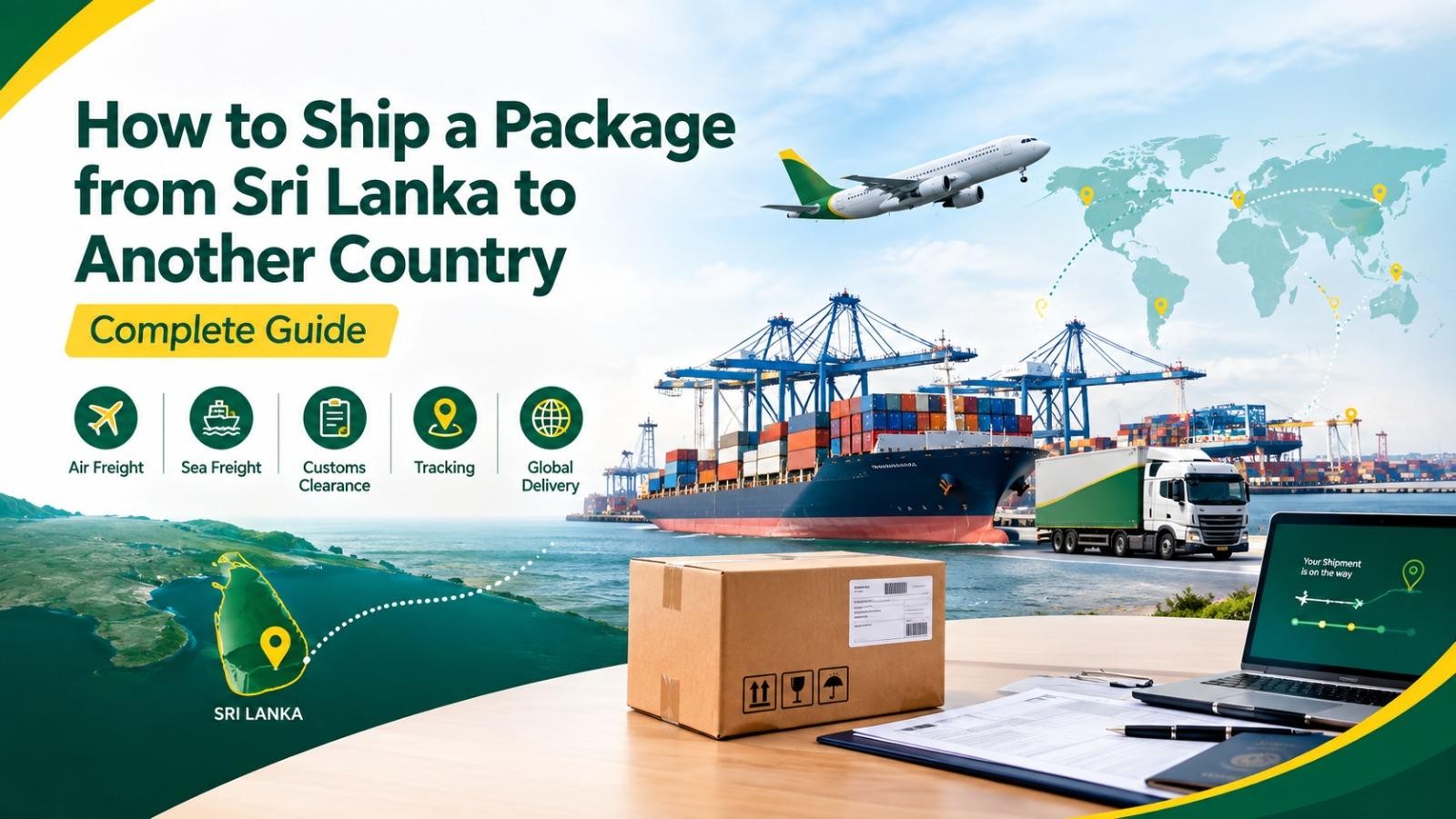
Whether you are an exporter sending products to overseas buyers, a small business fulfilling international orders, or an individual relocating goods abroad, international shipping can feel complicated. Choosing the right transport method, preparing documents, and clearing customs all affect how quickly and safely your package arrives. In this guide, Fletching Logistics explains exactly how to ship a package from Sri Lanka to another country, step by step.
To understand how to ship a package from Sri Lanka to another country, follow these basics: check what the destination country allows, choose air or sea shipping based on urgency and budget, pack and label the goods securely, prepare a commercial invoice and packing list, complete export customs clearance in Sri Lanka, and track the shipment until it clears customs at the destination. Using an experienced freight forwarder simplifies every stage.
Air freight is the fastest option for international shipping and is ideal for urgent, high-value, or time-sensitive goods such as samples, garments, electronics, spare parts, and perishables. A professional air freight forwarding service manages airline bookings, documentation, and tracking. Transit usually takes between 1 and 7 days depending on the destination and service type.
Sea freight is the most cost-effective choice for heavy, bulky, or large-volume shipments. You can ship a Full Container Load (FCL) if you have enough cargo to fill a container, or Less than Container Load (LCL) if you share container space with other shippers. A reliable sea freight forwarding service helps you choose the right option and route.
Before goods leave Sri Lanka, they must reach the port or airport. Road freight forwarding services move cargo from factories and warehouses to Colombo Port or Bandaranaike International Airport, while a rail freight transport service can be a cost-effective option for moving bulk cargo over longer inland distances.
For complex routes, a multimodal transport service combines road, sea, air, and rail under one coordinated plan. This is useful for reaching inland destinations overseas or balancing speed and cost.
Every country has its own import regulations. Confirm that your goods are allowed, whether permits or certificates are required, and what duties or taxes may apply at the destination.
Decide between air, sea, or multimodal transport based on delivery deadlines, budget, package size, and the nature of the goods.
Use strong boxes, pallets, or crates suited to the cargo. Protect fragile items with cushioning, seal packages securely, and use moisture protection for sea shipments, especially for goods like tea, spices, or textiles.
Record accurate weight and dimensions. Air freight is charged on chargeable weight, which is the higher of the actual weight or volumetric weight, so compact packing can reduce costs.
Include the shipper and consignee names, full addresses, contact numbers, and handling marks such as "Fragile" or "This Way Up" where relevant.
Common documents include:
Your goods must be cleared by Sri Lanka Customs before departure. Working with an experienced customs clearing agent in Sri Lanka helps ensure declarations are accurate, duties are handled correctly, and delays are avoided.
Your freight forwarder books space with airlines or shipping lines and arranges transport of your cargo to the airport or port.
Monitor progress using your AWB, B/L, or booking number. With Fletching Logistics, you can track your shipment for updates throughout its journey.
At the destination, the goods go through import customs clearance. Once duties and taxes are settled, the package is delivered to the consignee.
Shipping costs depend on the transport mode, weight and volume, destination, urgency, type of goods, packaging, insurance, fuel surcharges, and customs duties. Agreeing on Incoterms such as EXW, FOB, CIF, or DDP with your buyer also determines who pays for each part of the journey.
Always check before shipping. Commonly restricted or prohibited items include flammable materials, explosives, weapons, narcotics, certain chemicals, lithium batteries, perishables without proper certification, counterfeit goods, and cash. In Sri Lanka, items such as antiques, some plants, and certain animal products may need special approval before export.
Double-check that all documents match the actual goods, declare the correct value and product description, use proper HS codes, pack goods to international standards, confirm the consignee's details, and book early during busy seasons. Most delays happen because of incomplete or inaccurate paperwork.
For large or heavy shipments, sea freight, especially LCL for smaller loads, is usually the most cost-effective. For very small personal parcels, postal or courier services may be more practical.
Air freight usually takes 1 to 7 days, while sea freight can take several weeks depending on the route, transshipment, and customs clearance times.
Costs vary based on weight, volume, destination, transport mode, and cargo type. The most accurate way to know is to request a customised quote.
Yes, in many cases, but the destination country may require food safety, phytosanitary, or labelling compliance. Check requirements before shipping.
It depends on the agreed Incoterms. Under DDP, the shipper pays; under most other terms, the consignee pays import duties at the destination.
Do I need a freight forwarder to ship from Sri Lanka? It is not always required, but a freight forwarder simplifies bookings, documentation, customs clearance, and tracking, reducing risk and delays.
What documents are needed to export goods from Sri Lanka? Typically a commercial invoice, packing list, AWB or Bill of Lading, customs export declaration, and any required certificates or permits.
Is air freight or sea freight better? Air freight is better for urgent, lightweight goods, while sea freight is better for heavy, bulky, and cost-sensitive shipments.
Can I track my international shipment? Yes. Shipments can be tracked using the order, booking, HAWB, HBL, or container number.
Can Fletching Logistics handle customs clearance? Yes. Fletching Logistics provides customs brokerage for both imports and exports.
Built on the heritage of St. Anthony's Group since 1942, Fletching Logistics is a trusted shipping and logistics company in Sri Lanka. We offer end-to-end solutions across air, sea, road, and rail, supported by a global network reaching over 200 destinations by air. Our team handles documentation, customs compliance, and real-time tracking, with tailored shipping solutions for businesses of all sizes.
Now you know how to ship a package from Sri Lanka to another country, let experts handle the details. Contact Fletching Logistics today for a customised shipping quote and reliable international delivery.