

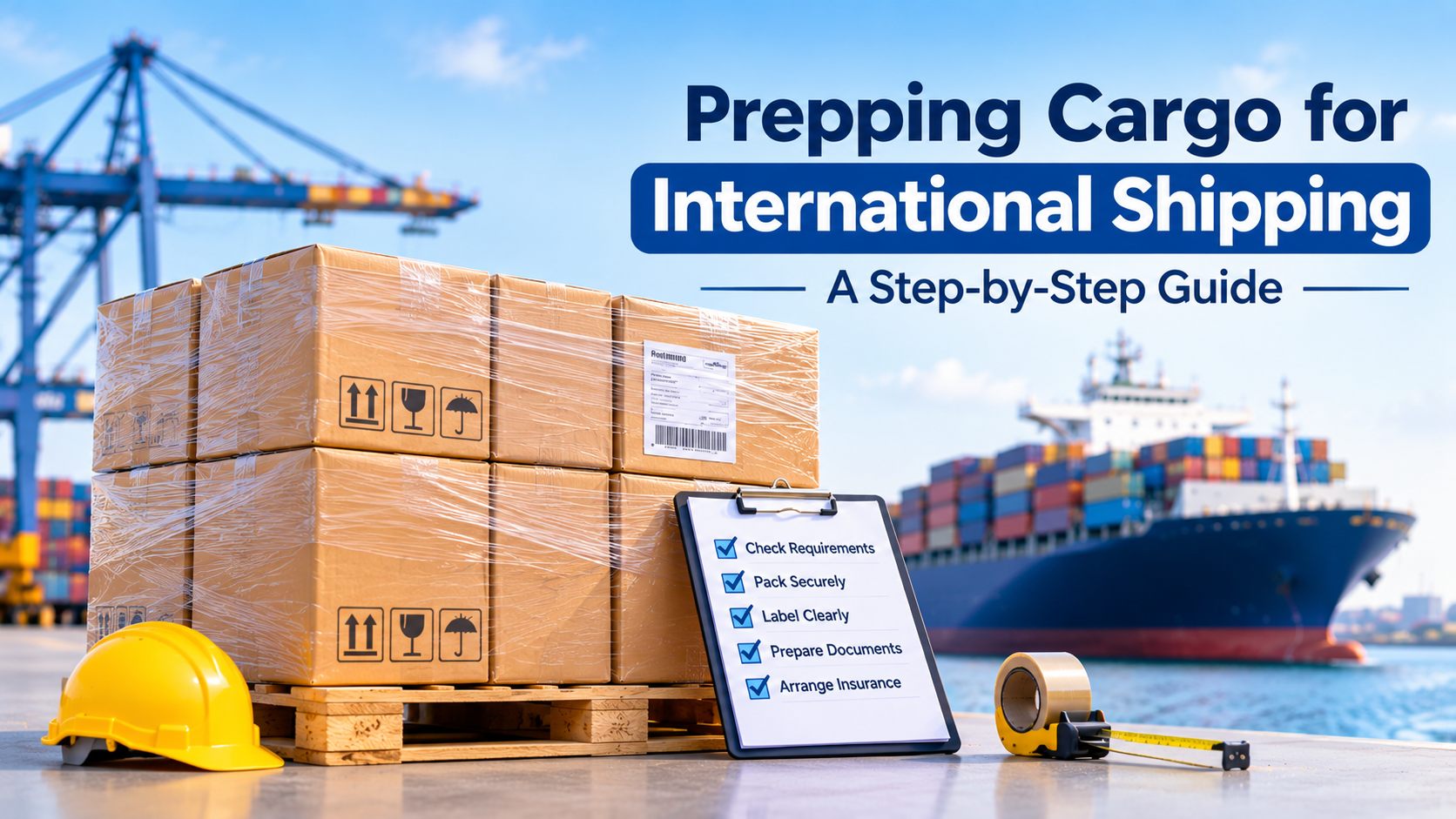
Quick answer: To prepare cargo for international shipping, confirm what you are shipping and whether the destination allows it, choose packaging that suits the journey, secure and label every unit, record accurate weights and dimensions, complete the export and import documents, arrange insurance, and book transport early enough for customs clearance. Most delays and damage claims can be traced back to one of these steps.
Goods crossing borders may be lifted, stacked, vibrated and exposed to humidity many times before they arrive. Customs officers and carriers also rely on your paperwork matching the shipment exactly. This guide from Fletching Logistics explains how to get your goods ready, what to check and which mistakes to avoid.
Good preparation does more than protect the product. It helps you:
Start by identifying the correct HS code. The first six digits are internationally harmonised, while countries add their own digits for further detail. Then check the destination’s rules for prohibited goods, permits, product standards and labelling. Food, plants, chemicals, medicines and electronics often need extra approvals.
Agree on an Incoterm in your sales contract. It sets out who arranges transport, who pays for each stage and where risk passes from seller to buyer. Clear terms prevent disputes over freight, insurance and clearance costs.
Use new or strong, undamaged export-grade cartons, and match the packaging to the weight, fragility and shipping mode. Sea cargo needs good moisture protection, while air cargo benefits from strong but lightweight packaging. Fill empty spaces so items cannot move, and cushion fragile products on all sides.
If you use solid wood pallets or crates, check that they meet ISPM 15. This international standard requires approved treatment and an official mark on regulated wood packaging.
Stack cartons squarely, keep heavy items at the bottom and avoid overhanging the pallet edge. Use stretch wrap, strapping and corner protectors to make each pallet stable. Inside a container, spread the weight evenly and brace the load so it cannot shift during the voyage.
Temperature changes at sea can cause condensation inside a container, often called container rain. Use dry packaging and pallets, add suitable desiccants, and consider liners or moisture barrier bags for sensitive goods. Inspect the container for holes, odours and dampness before loading.
Each package should show the consignee, destination, package number, weight and any reference number required by your buyer. Add recognised handling symbols, such as “this way up” or “fragile”, where relevant. Remove old labels from reused packaging so handlers are not misled.
Measure the goods after packing, including pallets. Carriers may charge on actual or volumetric weight, so accurate figures help avoid billing changes. For containerised sea cargo, SOLAS rules require the shipper to provide a Verified Gross Mass (VGM) before the container is loaded onto the vessel.
Make sure product descriptions, quantities, weights and values match across every document. A customs brokerage specialist can review requirements and help you avoid clearance problems.
Carrier liability is usually limited, so consider cargo insurance for the full value of the goods. Then plan each leg of the journey. Road transport usually moves cargo for international shipping from your factory or warehouse to the port or airport, where sea freight or air freight takes over. For routes with several legs, multimodal transport keeps the journey under one plan.
Requirements vary by product and country, but most shipments involve some of the following:
Use strong export packaging, cushion the contents, fill empty spaces, seal every seam and secure cartons to a pallet where suitable. Packaging should withstand stacking, vibration, repeated handling and changing humidity.
The commercial invoice, packing list and transport document are the usual starting point. Depending on the goods and destination, you may also need permits, a certificate of origin or product certificates.
There is no single global list. Restrictions depend on the origin, destination and transport mode. Weapons, certain chemicals, some batteries, food, plants and counterfeit goods commonly face limits or bans, so check before booking.
The commercial invoice shows the financial details of the sale and is used to assess duties. The packing list describes how the goods are packed, including package counts, weights and dimensions.
Start as soon as the order is confirmed. Allow extra time if your goods need permits, testing, fumigation or custom crates.
Solid wood packaging generally does. Highly processed materials such as plywood and particle board are usually exempt, but confirm the rules of the destination country.
Yes. Sea cargo needs stronger protection against moisture and longer transit, while air cargo needs careful control of weight and volume. Dangerous goods rules also differ by mode.
The seller or shipper is usually responsible for suitable packaging unless the contract says otherwise. Poor packing can also affect an insurance claim.
Yes. A forwarder can advise on documents, routing, cargo requirements and booking, which is especially useful for first-time exporters. Ask early so any issues can be fixed before pickup.
Careful preparation protects your goods, your budget and your customer relationships. If you have a shipment coming up, speak with Fletching Logistics to plan your international shipping from pickup to final delivery.