

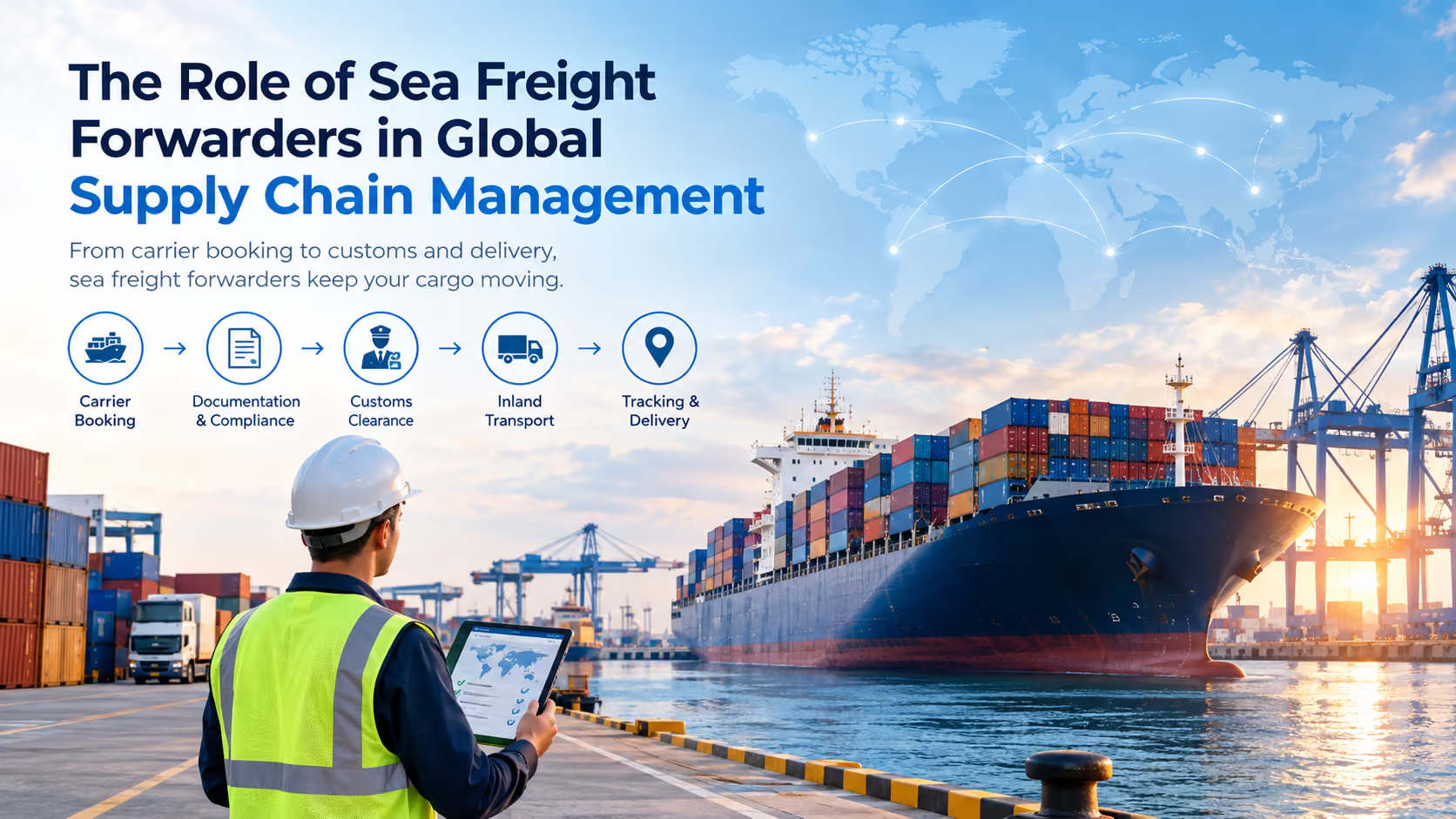
A single container moving from a factory in Sri Lanka to a warehouse in Europe passes through a dozen hands: trucking companies, port terminals, customs authorities, shipping lines, transshipment hubs, and destination agents. Any one of them can delay the shipment. Someone has to coordinate all of it, hold the paperwork together, and tell you where your cargo actually is. That is the job of a sea freight forwarder, and it is far more central to supply chain management than most businesses realise. This guide from Fletching Logistics explains exactly what forwarders do and why they matter.
A sea freight forwarder manages the end-to-end movement of cargo by sea on behalf of a shipper. This includes assessing cargo and planning routes, booking space with carriers, selecting and arranging containers, consolidating LCL shipments, preparing and managing documentation, coordinating customs clearance, arranging inland transport and insurance, and tracking the shipment through to delivery. A forwarder does not own the vessels; it uses carrier relationships and expertise to move your cargo efficiently and compliantly.
Forwarders add planning, compliance, and coordination on top of physical transport, which is why they sit at the centre of international logistics.
Forwarders assess cargo type, volume, destination, and deadlines, then design the most efficient routing. This may mean a direct service, a transshipment route, or combining modes through multimodal transport solutions to reach inland destinations.
Through established carrier relationships, forwarders secure space and rates that individual shippers would struggle to obtain, particularly during peak season or capacity shortages.
Choosing between FCL and LCL, and between dry, reefer, flat rack, or ventilated containers, directly affects both cost and cargo condition. Forwarders also consolidate smaller shipments so that lower-volume exporters still access ocean freight economics.
Bills of Lading, commercial invoices, packing lists, certificates of origin, and customs declarations must all agree with each other and with the cargo. Most delays in international shipping come from paperwork, not ships.
A forwarder working with an experienced customs clearing agent in Sri Lanka ensures correct HS classification, accurate declarations, and faster cargo release at both origin and destination.
Cargo must reach the port and leave it again at the other end. Forwarders arrange road freight forwarding services for first and last-mile movement, and rail freight transport where bulk cargo travels longer inland distances.
Forwarders advise on marine cargo insurance, packaging standards, and container selection to reduce the risk of damage, loss, or moisture issues during long voyages.
Real-time shipment visibility lets businesses plan production, inventory, and customer commitments with confidence. Fletching Logistics customers can track their shipment using their booking, HBL, or container number.
Port congestion, vessel delays, rolled bookings, and customs queries happen. A forwarder's real value often shows in how quickly these are resolved, including switching to air freight forwarding when a shipment becomes urgent.
By optimising container utilisation, consolidating shipments, avoiding demurrage through accurate documentation, and selecting efficient routes, forwarders reduce total landed cost rather than just freight rates.
Working with a capable forwarder improves far more than shipping. Businesses gain more predictable transit times for better inventory planning, lower total landed costs, fewer customs delays and penalties, reduced administrative burden on internal teams, better cargo protection, and a single point of accountability instead of chasing multiple vendors. For small and medium exporters especially, a forwarder effectively provides a logistics department without the overhead.
A freight forwarder manages the whole shipment journey, while a customs broker specifically handles customs clearance. Many forwarders, including Fletching Logistics, provide both.
International sea freight shipping can take anywhere from 2 to 6 weeks or more, depending on the route, sailing frequency, transshipment points, port congestion, and customs clearance.
Rates depend on FCL or LCL choice, cargo volume in CBM, weight, destination port, carrier, fuel surcharges, and seasonal demand. Booking early generally secures better rates.
Yes, in most cases. LCL consolidation means smaller exporters can still ship cost-effectively while the forwarder handles documentation and clearance.
Often, yes. Better container utilisation, consolidation, accurate paperwork that avoids demurrage, and efficient routing reduce total cost even where the freight rate looks similar.
Does a freight forwarder own ships? No. Forwarders work with multiple shipping lines to secure the best routes, schedules, and pricing for each shipment.
What is the difference between FCL and LCL? FCL means your cargo occupies an entire container. LCL means smaller shipments share container space, making ocean freight viable at lower volumes.
Is my cargo insured automatically? Not usually. Marine cargo insurance is typically arranged separately and is strongly recommended for valuable shipments.
Can I track my sea freight shipment? Yes. Tracking is available throughout the journey using your booking, HBL, or container number.
Does Fletching Logistics handle imports as well as exports? Yes. We manage sea cargo services in Sri Lanka for both imports and exports, including transshipment cargo.
Built on the heritage of St. Anthony's Group since 1942, Fletching Logistics is a trusted shipping and logistics company in Sri Lanka. We deliver end-to-end solutions across sea, air, road, and rail, handling booking, consolidation, documentation, customs coordination, insurance, and tracking. With strong global carrier partnerships, competitive pricing, and 24/7 customer support, we help businesses of all sizes build more reliable supply chains.
The right forwarding partner turns international shipping from a recurring headache into a competitive advantage. Contact Fletching Logistics today for a customised sea freight solution and expert supply chain support.