

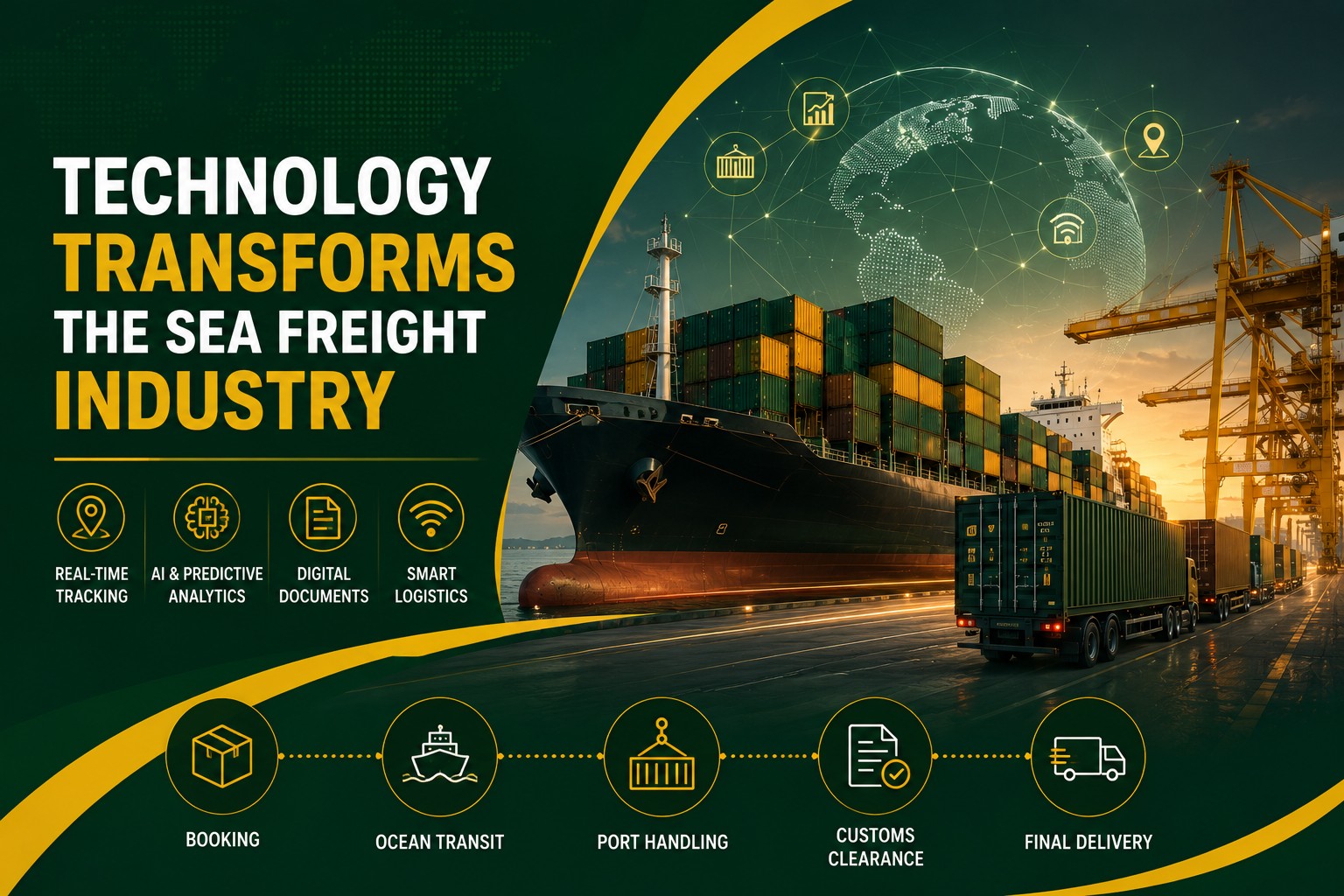
The Sea Freight Industry is changing rapidly as digital technology reshapes how cargo is booked, tracked, documented, monitored and delivered. What was once a highly paper-based and manually coordinated process is becoming more connected, automated and data-driven.
From artificial intelligence (AI) and Internet of Things (IoT) sensors to real-time tracking, electronic documentation and predictive analytics, technology is helping shipping companies and freight forwarders improve visibility, reduce delays and make better operational decisions.
For importers and exporters, this transformation means greater shipment visibility, faster communication and more efficient supply chain management.
International trade involves multiple parties, including exporters, importers, shipping lines, ports, customs authorities, freight forwarders, warehouses and transport providers. Coordinating all these stakeholders can create delays when information is exchanged manually.
Technology helps connect these processes through shared digital platforms, automated workflows and real-time data.
Some of the biggest technology trends influencing the Sea Freight Industry include:
The result is a move from reactive logistics to more proactive supply chain management.
One of the most important changes is improved shipment visibility. Modern tracking systems can provide information about shipment status, container movements and estimated arrival times.
Instead of waiting for manual updates, businesses can monitor cargo throughout different stages of its journey.
For example, real-time visibility can help an importer prepare warehouse capacity, arrange inland transportation and plan inventory before the shipment arrives.
Fletching Logistics incorporates shipment visibility into its logistics approach, supporting customers with tracking and coordinated communication across the shipping process. Businesses can explore the Sea Freight Forwarding Service to understand how technology-supported visibility fits into modern ocean freight operations.
AI is increasingly being used to analyse large amounts of logistics data.
In the Sea Freight Industry, AI can support:
Instead of simply responding to a delay after it happens, predictive systems can identify potential problems earlier.
For example, if historical and current data indicate that a particular route is likely to experience congestion, logistics teams can evaluate alternative schedules or routing options before the problem significantly affects delivery.
IoT technology allows physical objects to send information through connected sensors.
In ocean shipping, sensors can potentially monitor factors such as:
This can be particularly valuable for sensitive cargo.
If temperature-sensitive goods are transported, connected monitoring can help logistics teams identify abnormal conditions earlier and take appropriate action.
Smart container technology therefore adds another layer of visibility and risk management to international cargo transportation.
Paper documentation has traditionally been an important part of international shipping. However, electronic documents are becoming increasingly relevant.
Electronic bills of lading (eBLs) can reduce dependence on physical documents, speed up information exchange and improve document visibility. In 2026, ISO published ISO 5909:2026, which addresses business processes and data interchange for electronic bills of lading using distributed ledger technology.
Sri Lanka is also exploring eBL adoption. Research by UNESCAP highlights benefits including faster document transmission, improved security and better visibility over document transfers, although wider adoption still faces regulatory and institutional challenges.
For businesses, the long-term objective is straightforward: less paperwork, fewer document-related delays and faster communication between trading partners.
Technology does not replace the complete freight forwarding process. Instead, it improves individual stages of the journey.
The shipper provides information such as cargo type, dimensions, weight, origin, destination and required delivery timeframe.
Digital systems can help logistics professionals compare available options and identify a suitable shipping plan.
Once the shipping plan is confirmed, booking information can be processed electronically.
This reduces repetitive manual data entry and makes communication between the freight forwarder and carrier more efficient.
Commercial invoices, packing lists, bills of lading and other shipping information can increasingly be managed through digital systems.
Automated document workflows can also help identify missing information before it creates a delay.
During transportation, tracking technologies can provide information about shipment progress.
Depending on the technology and service, businesses may receive updates on container location, estimated arrival and other relevant conditions.
Analytics and AI can help identify potential disruptions such as delays, congestion or schedule changes.
The logistics team can then communicate with the customer and consider alternative solutions.
When the shipment approaches its destination, tracking information can help coordinate customs clearance, inland transportation and final delivery.
This creates a more connected process from origin to destination.
Businesses can obtain more information about where their cargo is and what stage of transportation it has reached.
Digital platforms reduce dependence on repeated emails, phone calls and manual status updates.
Automated workflows can reduce repetitive data entry and help identify incomplete information.
Better data can help businesses analyse routes, schedules, container utilisation and other cost factors.
Predictive analytics and real-time information can help logistics teams respond to potential disruptions earlier.
When shipment information is available sooner, companies can coordinate inventory, warehouses and transportation more effectively.
Choosing a technology-enabled freight forwarder is becoming increasingly important. Businesses should look beyond price and evaluate the overall service capability.
Consider these factors:
Fletching Logistics provides sea freight solutions covering cargo planning, carrier booking, containerisation, documentation, customs coordination and shipment visibility. Its broader logistics capabilities also cover road, air, rail, transshipment and customs brokerage services.
Businesses looking to understand the wider freight forwarding process can also read Freight Forwarding in Sri Lanka: A Complete Guide.
Technology offers significant advantages, but implementation is not always simple.
Different companies may use different systems, creating data-sharing challenges. Smaller businesses may also face investment and training requirements.
Cybersecurity is another important consideration because digital logistics systems handle commercially sensitive shipment and customer information.
There can also be regulatory barriers. Sri Lanka's experience with electronic bills of lading shows that technology adoption depends not only on available software but also on regulatory acceptance, banking processes, customs procedures and industry-wide cooperation.
Therefore, successful digital transformation requires technology, skilled people, appropriate processes and cooperation across the supply chain.
Technology is making ocean freight more visible, automated and data-driven. AI, IoT, digital documentation, tracking systems and analytics are helping businesses improve planning, communication, cargo visibility and operational efficiency.
AI can analyse large datasets to support route planning, ETA prediction, demand forecasting, capacity management and risk identification. This can help logistics teams make decisions before potential disruptions become major problems.
IoT refers to connected devices and sensors that collect and transmit information. In sea freight, IoT technology can be used for container location tracking and monitoring conditions such as temperature, humidity and movement.
Electronic bills of lading are becoming increasingly important, but adoption is not yet universal. Regulatory, banking, customs and trading-partner requirements can affect whether eBLs can be used for a particular transaction.
Technology does not necessarily make a vessel physically travel faster. Instead, it can reduce administrative delays, improve planning, provide earlier warnings about disruptions and make coordination more efficient.
Businesses can use carrier tracking systems or tracking services provided by freight forwarders. Depending on the service, tracking may provide shipment milestones, container information and estimated arrival updates.
Yes. A freight forwarder with strong digital capabilities can provide better shipment visibility, communication, documentation management and operational coordination. However, technology should be combined with experienced logistics professionals and strong carrier and customs knowledge.
The future of the Sea Freight Industry will be increasingly connected. AI-powered decision-making, IoT-enabled cargo monitoring, digital documentation, automation and advanced analytics are likely to become more integrated into everyday logistics operations.
For businesses, the key is not simply adopting the newest technology. The goal is to use technology that solves practical logistics problems: improving visibility, reducing unnecessary delays, controlling costs and making international trade easier to manage.
As global supply chains become more complex, technology-enabled freight forwarding will play an increasingly important role in helping businesses move cargo efficiently and respond quickly to changing conditions.
Fletching Logistics combines freight forwarding expertise with a broader end-to-end logistics approach for businesses moving cargo internationally. To discuss your shipping requirements, contact Fletching Logistics or explore the Fletching Logistics home page for more information about its logistics solutions.