

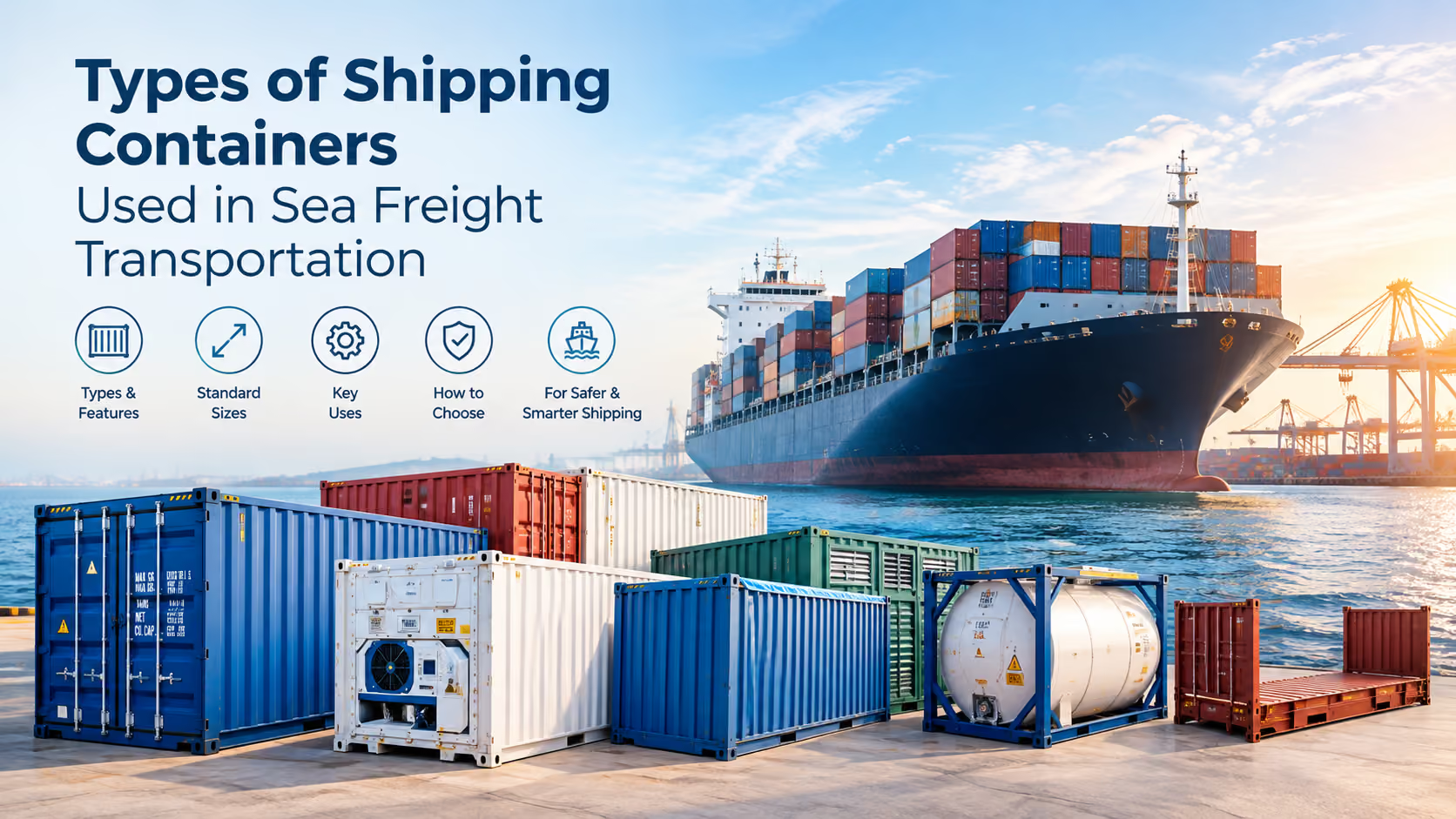
Around ninety percent of world trade moves by sea, and almost all of it travels inside a steel box. Those boxes look identical from a distance, but they are not. Ship a container of tea in the wrong type and it arrives damp. Load an oversized machine into a standard box and it will not fit at all. Choosing correctly affects your costs, your transit time, and whether your cargo arrives in sellable condition. This guide from Fletching Logistics explains the main types of shipping containers used in sea freight, their standard sizes, and how to pick the right one.
The main types of shipping containers used in sea freight are dry containers for general cargo, reefer containers for temperature-controlled goods, open top containers for cargo loaded from above, flat rack containers for oversized or heavy items, tank containers for liquids, ventilated containers for agricultural produce, high cube containers for extra volume, and specialised types such as insulated and garment-on-hanger containers. Standard lengths are 20 feet and 40 feet.
Capacities vary by manufacturer and container age, so always confirm exact dimensions with your freight forwarder before planning a load. TEU stands for Twenty-foot Equivalent Unit, the standard measure of container capacity on vessels.
The workhorse of global trade. Fully enclosed steel boxes with doors at one end, used for most general cargo including boxed goods, palletised stock, garments, machinery parts, and consumer products. Available in 20ft and 40ft lengths.
Best for: Most dry, non-perishable cargo.
Essentially a dry container with roughly one extra foot of internal height. The additional volume suits bulky but lightweight cargo where you hit the volume limit before the weight limit.
Best for: Furniture, textiles, light machinery, and voluminous goods.
Insulated containers with an integrated refrigeration unit that maintains a set temperature throughout the voyage. They plug into the vessel's power supply at sea and into shore power at terminals.
Best for: Seafood, fruit and vegetables, dairy, pharmaceuticals, flowers, and chilled or frozen goods. Exporters of Sri Lankan seafood and fresh produce rely on these heavily.
A standard container with a removable tarpaulin roof instead of a fixed steel top, allowing cargo to be craned in from above.
Best for: Tall machinery, timber, scrap metal, and cargo that cannot pass through standard doors.
A container base with collapsible or fixed end walls and no side walls or roof, giving access from the sides and above.
Best for: Heavy machinery, vehicles, generators, pipes, steel coils, boats, and project cargo that exceeds standard dimensions.
A cylindrical tank mounted inside a steel frame to standard container dimensions, allowing liquids to travel safely within normal container handling systems.
Best for: Liquid chemicals, edible oils, resins, and certain food-grade liquids. Hazardous liquids require additional compliance and documentation.
Fitted with ventilation openings that allow airflow while keeping rain out, preventing condensation and moisture damage during long voyages.
Best for: Coffee, cocoa, tea, spices, and other agricultural produce that releases moisture. Highly relevant for Sri Lankan exporters.
Insulated walls without an active refrigeration unit, helping to slow temperature change rather than control it.
Best for: Cargo needing protection from temperature swings but not a fixed cold temperature.
Also available are garment-on-hanger containers fitted for hanging apparel, platform containers with no sides or ends for extremely oversized loads, half-height containers for dense bulk cargo such as minerals, and double-door containers that open at both ends for easier loading.
Professional sea freight forwarding services help you match the container type to your cargo, route, and budget.
Smaller exporters often start with LCL and move to FCL as volumes grow.
A container's journey rarely begins or ends at the quayside. Inland movement to and from Colombo Port is handled by road freight forwarding services, while bulk inland transport over longer distances can use rail freight transport. For urgent cargo that cannot wait for a vessel, air freight forwarding is the alternative, and complex routes combining several modes are managed through multimodal transport solutions. Every loaded container also needs correct declarations, which is where an experienced customs clearing agent in Sri Lanka prevents costly delays. Once your container is at sea, you can track your shipment using your booking, HBL, or container number.
Distribute weight evenly across the container floor and never exceed the maximum payload marked on the door. Secure cargo with lashing, dunnage, and blocking to prevent movement at sea. Use moisture protection such as desiccants and liner bags for tea, spices, and textiles, since condensation inside containers is a common cause of damage. Inspect the container before loading for holes, dents, odours, and previous cargo residue, and photograph the loaded container before sealing.
A 40ft container offers roughly double the internal volume of a 20ft but not double the weight capacity. Dense, heavy cargo often fills a 20ft on weight before filling it on volume.
A reefer container, which maintains a controlled temperature throughout the voyage.
Maximum payload varies by container type, size, and age, and is marked on the container door. Your freight forwarder will confirm the limit for your booking.
A flat rack or open top container, depending on whether the cargo needs side access, top loading, or both.
Can I ship liquids in a standard dry container? Small packaged quantities may be acceptable, but bulk liquids need a tank container or approved flexitank arrangement.
Which container suits tea and spice exports? Ventilated containers help prevent moisture damage, and proper lining and desiccants add further protection.
Do I need a full container for a small shipment? No. LCL lets you pay only for the space your cargo occupies.
Can Fletching Logistics advise on container selection? Yes. Our team assesses your cargo type, volume, destination, and timeline to recommend the right container and shipping option.
Built on the heritage of St. Anthony's Group since 1942, Fletching Logistics is a trusted shipping and logistics company in Sri Lanka. We manage container shipping, consolidation, documentation, customs coordination, insurance, and tracking, supported by strong global carrier partnerships. Our team provides tailored container solutions for FCL, LCL, and specialised cargo, with port-to-port and door-to-door options.
The right container protects your cargo and your margins. Contact Fletching Logistics today for expert advice and a customised sea freight quote.